
Untapped New York publishes monthly articles by Jo Holmes about the life and work of the late architect Richard Roth Jr. (founder of Emery Roth & Sons). Each article focuses on a different building and developer where Richard worked, interspersed with personal stories and exclusive interviews with Holmes and Justin Rivers of Untapped New York (available in our on-demand video library). Click here to watch the entire series!
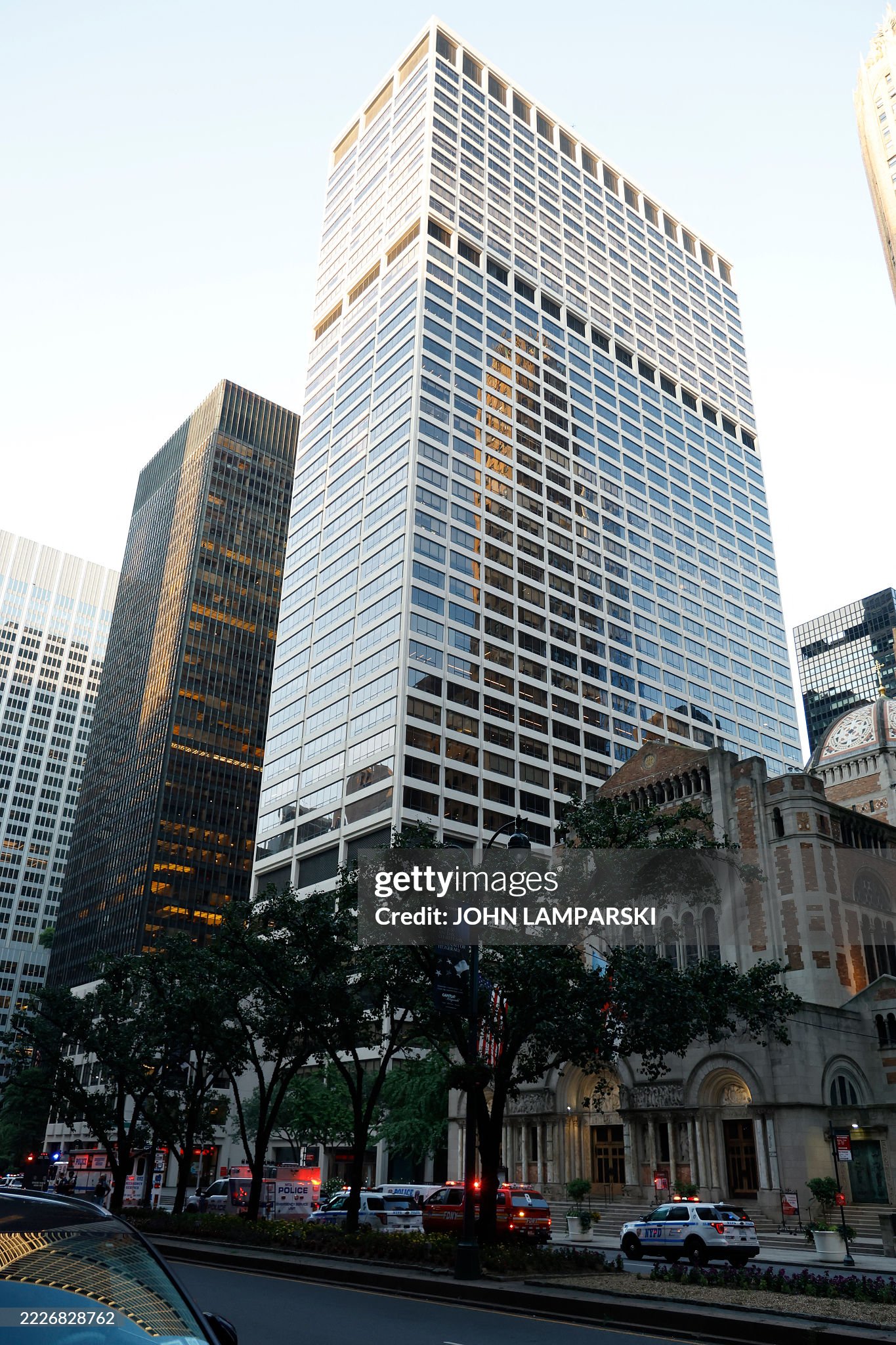
The building at 345 Park Avenue, occupying an entire block, is a massive structure with its own ZIP code. The site abuts Park and Lexington Avenues, as well as 51st and 52nd Streets. Completed in 1969, this iconic building was designed by Richard Ross II and is owned by the Rudin family, one of the most active in New York City real estate.
Richard considered the project a significant challenge, perhaps even a daunting task, not only because of its sheer size but also because of its location. It sits between two of the city’s most distinctive yet contrasting buildings: the International Style Seagram Building designed by Mies van der Rohe and the Byzantine-style St. Bartholomew’s Church.
Emory-Roth & Co.’s projects were highly sought after in their day—in fact, the term “Roth skyscraper” was used specifically to describe the numerous high-rise office buildings the company built. While the architectural style may have differed from the Emory era, the company’s operating model has remained unchanged for nearly a century. Its organizational structure and processes differ somewhat from its competitors, and Richard believes these differences often give the company a competitive advantage.
In the late 1960s, Rudin Management acquired the site of the former Ambassador Hotel (demolished in 1966) and the adjacent Park Avenue property. They commissioned Richard to design the largest office building permitted for the site.
This site features two striking neighbors with contrasting styles. To the north is the Seagram Building, completed in 1958. Designed by then-distinguished architects Mies van der Rohe and Philip Johnson, this 157-meter skyscraper has won numerous awards and made history for its use of materials and construction.
To the south is St. Bartholomew’s Church, built between 1916 and 1917. “St. Bartholomew’s Church is modeled on a much older building near Avignon in the south of France. A few years later, I specifically visited this church because it caught my eye. The facades of the two churches are exactly the same. It’s right in this city. St. Bartholomew’s Church itself is also a beautiful building,” Richard said. He was very concerned about whether his new building would harmonize with the style of these two landmarks.
”I told the Rudins, ‘You know, this place needs to be built on something like an elephant, not an elephant sandwiched between two magnificent buildings.’ Frankly, it was the most challenging design challenge I’ve ever faced,” Richard admitted.
To some extent, Richard and Rudin agreed. “They wanted a ‘legal’ building.” In other words, the project had to strictly comply with all zoning regulations, requiring no special permits or “exceptions.” “They didn’t want to build a building that would require applications to the planning commission, the historic preservation agency, and the local community board. They wanted to avoid all that hassle as much as possible. I agreed with them because I knew there would be resistance. No matter what I did, I’d still get a negative response,” Richard explained.
However, disagreements remained, some of which Richard won, others of which he lost. “I was very concerned about the color issue. I said we don’t want another black building on Park Avenue. I said this building should be light-colored, so it would be less noticeable. Although making a 50-story building completely invisible is no easy task…” Ultimately, the Rudins agreed to a more refined version of Richard’s previous design for New Britain Bank Trust. (That building was seven stories high; the final version is 193 meters tall and has 44 floors.)
”It’s a background color that’s subtle. It’s different from the church, which is a good thing, because if it were the same color, it would be too garish. It’s lighter, so it blends in better with the surroundings and is less noticeable—I’ve already painted enough black buildings!” Richard said.
Richard tried to “coordinate” with the Seagram Building, but ultimately failed. “I said the lobby should be the same height as the lobby in the Seagram Building. I said, ‘You have a huge building here, and you want me to build a lobby that’s 15 feet high.’”
Richard strongly advocated for a double-height lobby. “It would have perfectly complemented the style of the Seagram building, but Jack Rudin was adamantly against it.” Richard believed it was pointless, as a double-height lobby wouldn’t reduce the leasable area—another floor would be enough. “The current lobby is too low for a building of this size.”
Richard oversaw the design of this project. This has always been his favorite part of the job. But he often says that some of the firm’s largest and most famous buildings were built in collaboration with them, serving as “co-architects.” Emory Ross & Sons is known for completing projects on time or even ahead of schedule, and consistently staying on or ahead of budget. This makes this type of business extremely attractive to clients.
Richard explained that many architectural firms are organized as teams, whose members possess a variety of skills and experience typically needed for architectural projects. These teams focus on specific projects. “Other firms take a collaborative approach—they form a team of all these individuals, led by a partner, and the team completes the project from start to finish,” Richard explained.
Emory Ross & Co. took a different approach. They had several separate departments, including design, detailed design, fabrication, and construction. Each department typically participated in all projects. (They outsourced structural and mechanical design firms.) Richard saw one advantage of this model as the ability to collaborate more closely with other firms on projects. “This way of working allows us to provide construction drawing services to the design architects… we simply include them in the process, ‘cutting out’ the detail design department in our office. They know nothing about the project. Conversely, when we, the design architects, develop plans in the design and detail design departments, those plans don’t even reach our fabrication department.”
For example, when Walter Gropius took on the Transamerica Tower project, his firm served as the design department. Meanwhile, Minoru Yamazaki oversaw the design of the World Trade Center, and Emory Ross & Co. was appointed “co-architect,” responsible for the design and, ultimately, the completion of the building.
In a 2018 interview with architectural historian Anis Alter, Richard explained that his firm was chosen to design the World Trade Center because it had designed more office buildings in New York City than any other architectural firm. Furthermore, the firm had just completed the extremely complex and large-scale Pan Am Tower project.
”It all started with Yamazaki developing a series of architectural designs… Due to the enormous size of the site, there were probably about 100 different proposals. Our team in New York—my uncle, my father, design director Irwin Gershon, and myself (the architectural director)—traveled to Detroit to view the models. After several hours of observation, conversation, and discussion, it became clear that the twin towers design was the best option… Once the design was approved by the Port Authority, it was immediately transferred to our office, where at that time there were probably about a hundred people involved in the project.”
Emory Ross & Sons also designed another iconic Manhattan skyscraper, the Citigroup Center (now Citigroup Tower). This 275-meter-tall building, located at 601 Lexington Avenue, boasts a distinctive pitched roof and 59 floors, offering 1.3 million square feet of office space. Designed by renowned Harvard-educated architect Hugh Stubbins (the ground floor now houses a food court called “Hugh’s”), the building’s nearly completed construction is no less fascinating. Beyond its impressive exterior, the story behind the building’s construction is equally fascinating.
”A concerned structural engineer named Bill LeMessurier contacted me because he realized that if wind speeds reached a certain level, the building’s corners could collapse,” Richard said. It turned out that two architecture students, unknown to each other, had questioned some of the calculations while reviewing the drawings. One of them contacted LeMessurier. To solve the problem, they added additional cross bracing and installed a damper on the roof. “It’s one of those rare cases where an engineer makes an unexpected mistake,” Richard said. The story was revealed in a 1995 article in The New Yorker, and historian Michael M. Greenberg explored the controversy in his book, “The Great Miscalculation,” published in 2025.
Despite some problems, Richard has fond memories of the building. “I think the Citibank Tower is a fantastic building. Stubbins’ design is superb. It was the first building with double-decker elevators, which reduced the volume of the central section and increased the leasable area. I also think the shopping area is wonderful. It’s a nice place, close to our offices, so we go there often.”
As Richard explained, there were also projects where they were solely responsible for the design. “For example, we designed two buildings in Detroit; we were the design architects for both. One was the Detroit Edison Building… and the other was the Detroit Bank Trust Building… I designed both.” (These two buildings were later renamed DTE Plaza and 211 Westford Street, respectively.)
Today, nearly 60 years after Richard designed the building at 345 Park Avenue, it has stood the test of time. Rudin Management still has its offices there. Richard enjoys visiting the square during summer lunchtimes to enjoy free outdoor jazz concerts. However, he had some reservations about the building. “I would have preferred it to be smaller,” he explained. But in meeting the client’s needs while harmonizing with the buildings on either side, he wasn’t disappointed with the end result. “Given the constraints of the time, I think I did the best I could.”
This article contains an affiliate link, which means Untapped New York will receive a commission. You won’t pay any additional fees, and the commission we receive will go toward supporting our mission of independent journalism!
Post time: Mar-20-2026