
A stone wall cladding support system is the hidden structural framework that secures natural or engineered stone panels to a building’s exterior or interior wall. Far more than a simple fixing method, it must safely transfer dead loads, wind loads, and dynamic forces while accommodating thermal movement, structural tolerances, and long-term durability.
The system typically begins with adjustable brackets or vertical support rails anchored directly to the structural backup wall—usually concrete, steel studs, or masonry—using stainless steel expansion anchors or through-bolts. Horizontal rails are then attached to these vertical members, creating a precisely aligned grid. The stone panels themselves are connected to the grid using individual stone anchors: either kerf inserts that engage a groove cut into the panel edges, or undercut (back-cut) anchors that lock into drilled cavities on the rear face without stressing the stone. Top-hung, bottom-supported configurations are common, where each panel rests on a support ledge or angle and is restrained at the head with wind clips to resist suction and positive pressure.
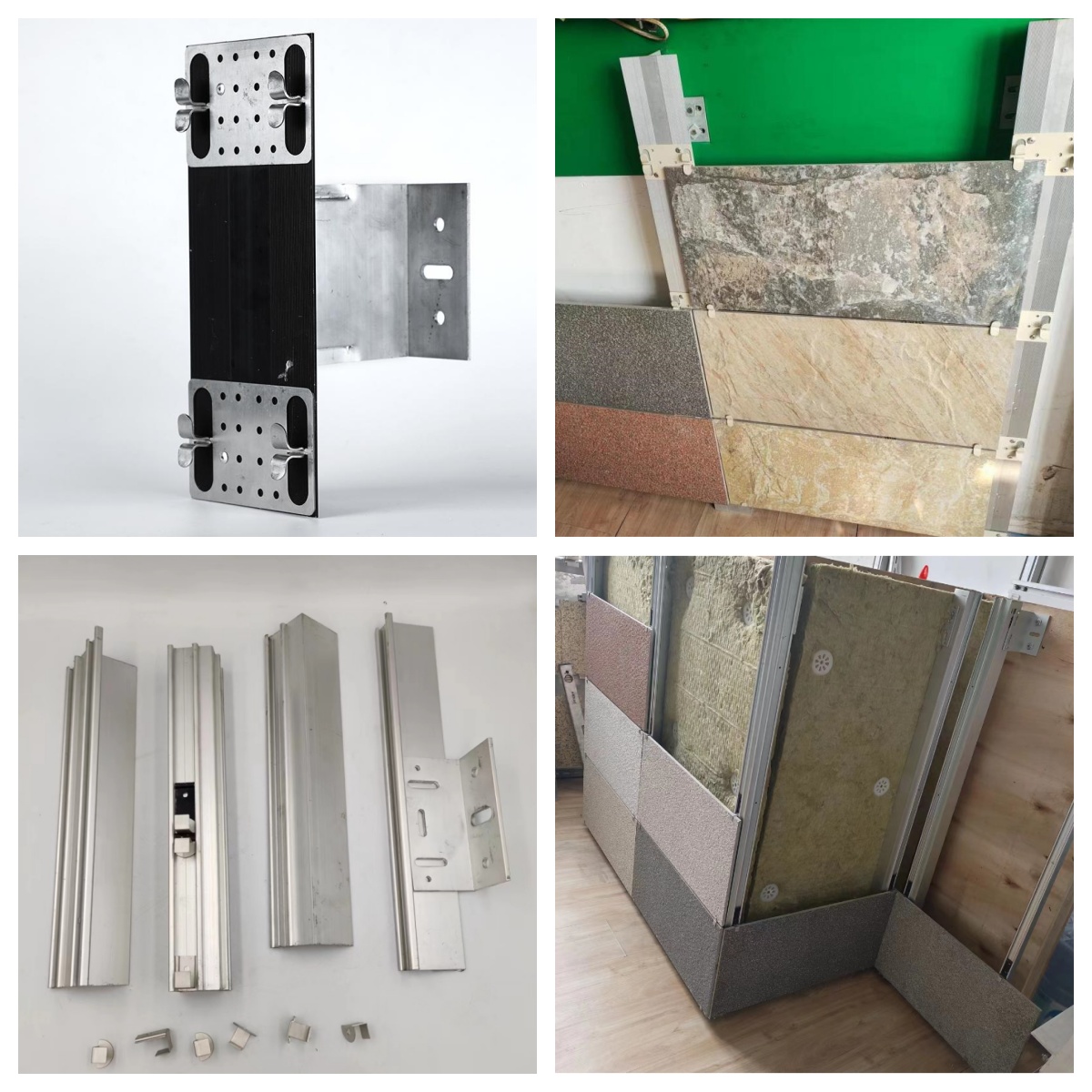
A well-designed support system incorporates a ventilated cavity behind the stone. This air gap, typically 25–50 mm, allows pressure equalization, promotes drainage of any incidental moisture, and prevents water from being driven into the building envelope. Movement joints between panels, along with slotted connections in the support rails, accommodate differential movement caused by temperature swings, humidity, and substrate drift—critical to avoiding cracked stone or popped anchors.
Material selection is equally vital. Marine-grade stainless steel (316L) for anchors and fasteners, corrosion-resistant aluminium or galvanized steel for rails, and EPDM or silicone gaskets for isolation ensure a service life measured in decades. Modern systems also employ proprietary adjustment mechanisms that allow three-dimensional micro-positioning (vertical, horizontal, and in-out) on site, achieving perfectly coplanar facades even when the structural wall is uneven.
By combining dead-load gravity supports with lateral wind restraint, drainage, and adjustability, the stone cladding support system transforms fragile stone into a robust, safe, and elegant building skin. Its success depends not only on engineering calculations but also on meticulous installation and rigorous corrosion protection—ensuring that the stone remains permanently fixed and beautifully aligned, year after year.
Post time: May-22-2026