
When you look at a towering skyscraper with a seamless glass facade or a modern airport terminal flooded with natural light, you are looking at a curtain wall system. Far from being just a “glass wall,” the curtain wall is one of the most sophisticated and essential technologies in contemporary construction.
What is a Curtain Wall?
A curtain wall is a non-structural, outer covering of a building. Unlike traditional load-bearing walls or concrete panels, a curtain wall does not support the roof or floor slabs above it. Instead, it is hung like a curtain on the outside of the building’s structural frame (usually made of steel or concrete).
Its primary job is to keep the weather out and the interior environment comfortable, while resisting air and water infiltration, wind loads, and seismic forces.
The “Curtain” Principle
The critical engineering distinction lies in how the wall handles loads:
· Traditional Walls (Barrier Walls): They support their own weight plus the weight of the floors/roof above.
· Curtain Walls: They support only their own weight (spanning from floor to floor) and transfer wind and seismic loads directly to the building’s structure at specific anchor points.
This allows architects to design lighter, taller buildings with thinner walls and more floor space.
Core Components of a Curtain Wall System
A modern curtain wall is a complex assembly of four key elements:
1. The Frame (Mullions & Transoms): The vertical members are called mullions, and the horizontal members are transoms. Typically made of extruded aluminum, this grid provides structural strength and dimensional stability.
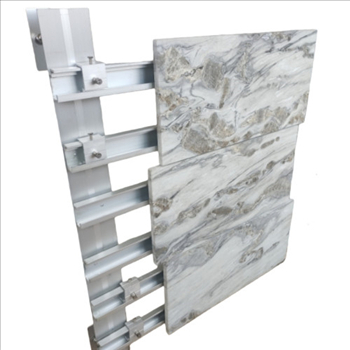
2. The Infill (Glass, Metal, or Stone): While glass is the most iconic infill, panels can also be made of aluminum sheets, thin stone veneer, or louvered vents.
3. The Gaskets & Sealants: These are the “soft” parts—silicone, EPDM rubber, or neoprene—that create a watertight and airtight seal between the frame and the glass.
4. The Thermal Break: A critical component made of polyamide (plastic) inserted between the interior and exterior halves of the aluminum frame. This prevents cold from traveling from the outside to the inside (thermal bridging), reducing condensation and energy loss.
Main Types of Curtain Wall Systems
There are two primary methods of assembling and installing curtain walls:
1. Stick-Built System
· How it works: The aluminum frame components (mullions and transoms) are cut to size in a factory, shipped to the site, and assembled piece-by-piece on the building. Glass and panels are then inserted into the frame.
· Pros: Lower material shipping cost; easier to handle on sites with limited crane access.
· Cons: Slow, labor-intensive installation; dependent on good weather; quality control is site-dependent.
2. Unitized (Modular) System
· How it works: Entire 3D “units” (typically one floor tall by one bay wide) are fully assembled, glazed, and sealed in a factory. These units are shipped to the site and simply bolted to the building’s edge slabs.
· Pros: Extremely fast installation; superior quality control (factory conditions); better water-tightness.
· Cons: Higher upfront manufacturing cost; requires precise planning and logistics.
Performance Demands (Why it’s hard)
A successful curtain wall must pass rigorous tests for four key areas:
· Air Infiltration: Preventing drafts. (ASTM E283)
· Water Penetration: Using “pressure equalization” chambers to stop rain from being pushed through the seals. (ASTM E331)
· Structural Load: Withstanding hurricane-force winds without breaking or deflecting too much.
· Thermal & Condensation Resistance: Preventing mold and moisture inside the wall cavity. (AAMA 1503)
Beyond Glass: Modern Trends
Today’s curtain walls are evolving into “intelligent skins.”
· Unitized systems now dominate high-rise construction due to speed and reliability.
· Double-Skin Facades: Two layers of curtain wall with a ventilated cavity in between for natural cooling.
· BIPV (Building Integrated Photovoltaics): Glass panels that act as solar panels, generating electricity.
· Dynamic Glazing: Electrochromic glass that tints automatically to reduce glare and heat gain.
Conclusion
The curtain wall is more than a facade; it is a weather defense system, a structural diaphragm, and a thermal regulator all in one. By divorcing the outer skin from the structural frame, it enabled the 20th century’s skyscraper boom and continues to drive 21st-century innovations in energy efficiency and smart materials. When you see a glass tower reflecting the sky, you are seeing a curtain wall performing its delicate balancing act between transparency and protection.
Post time: Apr-17-2026